
Transforming Waste into Resources Through Circular Economy Solutions
The traditional economic model of “take, make, and dispose” has placed unprecedented pressure on natural resources, ecosystems, and waste management systems worldwide. As populations grow and consumption increases, the challenge is no longer simply how to manage waste, but how to reduce waste generation and maximize resource efficiency throughout the value chain.
This challenge lies at the heart of Sustainable Development Goal 12: Responsible Consumption and Production.
SDG 12 promotes efficient use of natural resources, reduction of waste generation, sustainable business practices, and the transition towards circular economy systems where materials remain in productive use for as long as possible.
For organizations operating in the waste management sector, SDG 12 represents one of the most directly relevant sustainability goals. Every tonne of waste diverted from landfill, every recyclable material recovered, and every resource returned to productive use contributes towards a more sustainable economy.
At Ghulam Hussain & Sons (GHS), responsible consumption and production principles are embedded within our long-term vision for environmental management.
For decades, waste management in Pakistan primarily focused on collection and disposal. While these functions remain essential, the future of environmental sustainability requires a more advanced approach that prioritizes waste reduction, recycling, material recovery, and resource optimization.
Recognizing this need, GHS has expanded beyond conventional waste collection services to actively support Waste-to-Value initiatives, recycling systems, and circular economy projects.
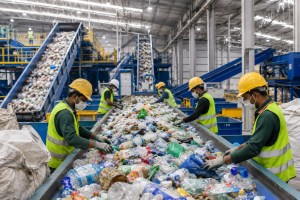
One of the most significant examples of GHS’s contribution towards SDG 12 is the establishment of Pakistan’s first integrated Zero Waste Recycling Facility at POF Wah Cantt.
The facility was designed to reduce landfill dependency by recovering recyclable materials, processing organic waste, and maximizing resource utilization. Instead of treating waste as a disposal problem, the facility views waste as a valuable resource capable of generating environmental and economic benefits.
The project demonstrates how circular economy principles can be successfully implemented within Pakistan’s waste management sector.
Learn more about
Solid Waste Treatment & Disposal Solutions
that support sustainable resource recovery and waste diversion.
GHS actively promotes the concept of Waste-to-Value, where materials traditionally considered waste are transformed into usable products, recycled materials, or alternative resources.
Our vision includes:
✔ Material Recovery Facilities (MRFs)
✔ Recycling infrastructure
✔ Composting systems
✔ RDF production
✔ Resource recovery initiatives
✔ Community recycling programs
These systems not only reduce environmental impacts but also create economic opportunities and support sustainable resource utilization.
Responsible consumption begins with public awareness.
Through partnerships such as the WWF Pakistan AMAL Recycling Program and
environmental awareness campaigns
conducted across more than 500 schools, GHS actively promotes responsible waste practices among future generations.
By encouraging segregation at source, recycling, and environmental responsibility, GHS contributes to long-term behavioral change that supports the objectives of SDG 12.
As Pakistan moves towards a more sustainable future, circular economy solutions will play an increasingly important role in reducing waste, conserving resources, and improving environmental performance.
Through Waste-to-Value projects, recycling infrastructure, sustainability initiatives, and community engagement programs, GHS remains committed to supporting the transition towards responsible consumption and production.
Through investments in
sustainability initiatives
and innovative environmental solutions, GHS continues to support the development of a more resource-efficient future.