
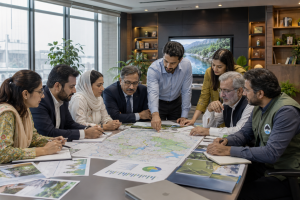
Driving Sustainable Development Through Collaboration
Sustainable development cannot be achieved by any single organization acting alone. Governments, private sector organizations, educational institutions, development agencies, civil society, and local communities must work together to address complex environmental challenges and create lasting solutions.
The importance of collaboration lies at the heart of Sustainable Development Goal 17, which promotes partnerships as a key mechanism for achieving sustainable development outcomes.
For over five decades, partnerships have played a central role in the growth and success of Ghulam Hussain & Sons.
Environmental challenges require collective action.
GHS has successfully partnered with municipal authorities, government institutions, industries, educational organizations, and environmental stakeholders to develop and implement integrated environmental solutions across Pakistan.
These partnerships have enabled the delivery of large-scale waste management systems, sustainability initiatives, recycling programs, and environmental awareness campaigns that create measurable impact for communities.
Through Solid Waste Management Solutions and integrated environmental services, GHS continues to support sustainable development objectives across multiple sectors.
Throughout its operational history, GHS has worked alongside numerous public-sector organizations, including:
✔ Rawalpindi Waste Management Company (RWMC)
✔ Lahore Waste Management Company (LWMC)
✔ Punjab Local Government Institutions
✔ Cantonment Boards
✔ Defence Housing Authority (DHA)
✔ Pakistan Ordnance Factories (POF)
✔ Suthra Punjab Authority
These collaborations have supported the delivery of municipal services, environmental management systems, public cleanliness operations, and sustainability-focused projects across Pakistan.
One of the most notable examples of successful partnership is the establishment of Pakistan’s first integrated Zero Waste Recycling Facility at POF Wah Cantt.
Developed under a Public-Private Partnership model, the project demonstrates how collaboration between public institutions and private-sector expertise can create innovative environmental infrastructure capable of supporting circular economy objectives.
The project remains one of the flagship sustainability initiatives within GHS’s portfolio.
Learn more about Solid Waste Treatment & Disposal Solutions that support resource recovery and sustainable waste management.
GHS has also collaborated with WWF Pakistan through the AMAL Recycling Program, helping promote recycling awareness and environmental responsibility among students and educational institutions.
Through this initiative, thousands of students have been engaged in recycling and environmental awareness activities that support long-term sustainability objectives.
These efforts complement broader Environmental Awareness Programs designed to encourage responsible environmental behavior.
The Government of Punjab’s Suthra Punjab Initiative represents another important example of partnership-driven environmental management.
Through collaboration with RWMC and provincial stakeholders, GHS currently manages waste operations in Murree District and Kotli Sattian while also contributing towards multiple tehsils across Punjab through joint venture operations under:
✔ DWMC
✔ MWMC
✔ FWMC
✔ GWMC
✔ RWMC
These partnerships demonstrate how public and private organizations can work together to improve environmental outcomes at scale.
As environmental challenges continue to evolve, collaboration will become increasingly important.
GHS is actively expanding its engagement in:
✔ Sustainability initiatives
✔ Carbon credit opportunities
✔ Waste-to-Value projects
✔ Recycling infrastructure
✔ Material Recovery Facilities
✔ Environmental awareness programs
✔ Climate resilience initiatives
By bringing together governments, industries, communities, investors, and development partners, GHS aims to accelerate Pakistan’s transition towards a cleaner, more sustainable future.
The future of environmental sustainability depends upon meaningful partnerships built on trust, innovation, and shared objectives.
Through public-private partnerships, strategic collaborations, and long-term stakeholder engagement, Ghulam Hussain & Sons remains committed to advancing the principles of SDG 17 and contributing towards sustainable development across Pakistan.
Future collaboration through digital sustainability platforms and environmental innovation initiatives will further strengthen collective impact and long-term environmental outcomes.