
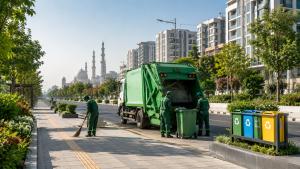
Building Cleaner, Healthier, and More Sustainable Urban Communities
Pakistan’s cities are growing at an unprecedented pace. Expanding populations, rapid urbanization, commercial development, industrial growth, and increasing consumer activity have significantly increased the amount of waste generated every day. As urban centers continue to develop, municipalities face mounting pressure to deliver efficient, sustainable, and environmentally responsible waste management services.
Modern waste management is no longer limited to collecting waste from households and transporting it to disposal sites. Today’s cities require integrated systems that combine waste collection, recycling, digital monitoring, environmental awareness, resource recovery, and sustainable disposal practices to maintain clean and livable urban environments.
For more than five decades, Ghulam Hussain & Sons (GHS) has supported municipalities, industries, housing societies, institutions, and public-sector organizations through integrated waste management services that improve cleanliness, operational efficiency, and environmental sustainability across Pakistan.
As cities expand, residential communities, commercial centers, healthcare facilities, educational institutions, shopping districts, tourism destinations, and industrial zones all generate larger volumes of municipal waste. Without effective planning, waste collection systems struggle to keep pace with growing demand.
Poorly managed waste can contribute to overflowing collection points, blocked drainage systems, environmental pollution, unpleasant odors, pest infestations, and reduced quality of life for residents.
Traditional waste collection systems focused primarily on transporting waste to disposal sites. Modern environmental management adopts a broader approach that emphasizes waste reduction, recycling, operational efficiency, sustainability, and environmental protection.
Professional Solid Waste Management Services combine collection, transportation, transfer stations, recycling initiatives, operational monitoring, and sustainability planning to deliver long-term environmental benefits.
Technology is improving the efficiency of municipal waste management across Pakistan and around the world. GPS-enabled fleet tracking, GIS mapping, digital attendance systems, complaint management platforms, route optimization software, and performance dashboards allow municipalities to deliver faster, more transparent, and more accountable waste management services.
These innovations reduce fuel consumption, improve collection schedules, strengthen operational monitoring, and support data-driven decision-making.
Our Environmental Consultancy Services help municipalities and organizations adopt smarter environmental management systems that improve service delivery and long-term sustainability.
Growing cities cannot rely indefinitely on landfill disposal. Recycling allows valuable materials such as paper, plastics, metals, glass, and cardboard to be recovered and returned to productive use, reducing landfill dependency while conserving natural resources.
Initiatives such as Pakistan’s 1st Zero Waste Recycling Facility demonstrate how recycling infrastructure supports cleaner cities and strengthens the country’s transition toward a circular economy.
Successful waste management depends not only on infrastructure but also on public participation. Households, businesses, schools, institutions, and community organizations all play an important role by segregating waste, supporting recycling programs, and adopting responsible waste disposal practices.
Programs like our Green Office & Green School Program help build environmental awareness while encouraging communities to take an active role in maintaining cleaner and healthier cities.
Modern cities require more than waste collection vehicles. Smart infrastructure such as transfer stations, material recovery facilities, recycling centers, properly planned collection routes, and digital monitoring systems enables municipalities to deliver reliable environmental services while improving operational efficiency.
Investing in modern infrastructure also reduces unnecessary transportation costs, minimizes environmental impacts, and improves service quality for residents and businesses.
A well-designed waste management system delivers benefits far beyond cleaner streets. It protects public health, reduces environmental pollution, conserves natural resources, supports recycling, lowers greenhouse gas emissions, and contributes to more resilient urban environments.
Businesses, municipalities, housing societies, and institutions that adopt sustainable waste management practices also strengthen their environmental performance while supporting national sustainability objectives.
For over five decades, Ghulam Hussain & Sons has partnered with municipalities, cantonment boards, industries, healthcare institutions, housing societies, and government organizations to deliver reliable environmental services across Pakistan.
Through integrated waste collection, transportation, street sweeping, recycling initiatives, environmental consultancy, and Waste-to-Value solutions, GHS continues to support cleaner, healthier, and more sustainable urban communities.
Organizations can also request a Free Waste Assessment to identify opportunities for improving waste management efficiency and environmental performance.
| Component | Contribution |
|---|---|
| Waste Collection | Maintains cleaner neighborhoods and public spaces. |
| Recycling | Recovers valuable resources and reduces landfill waste. |
| Digital Monitoring | Improves efficiency and operational transparency. |
| Community Awareness | Encourages responsible waste disposal and recycling. |
| Environmental Consultancy | Supports sustainable planning and long-term environmental improvement. |
Pakistan’s cities will continue to grow over the coming decades, making modern waste management more important than ever. Investing in smart technologies, recycling infrastructure, environmental education, and sustainable operational systems will help cities remain clean, resilient, and environmentally responsible while improving the quality of life for future generations.
Through integrated waste management, recycling initiatives, digital innovation, environmental consultancy, and sustainability-focused solutions, Ghulam Hussain & Sons remains committed to helping Pakistan’s cities build a cleaner and more sustainable future.
Partner with Ghulam Hussain & Sons for reliable municipal waste management, recycling, environmental consultancy, and smart sustainability solutions that keep communities cleaner and healthier.